
Fictional climate puzzle · In development
Swell Joint
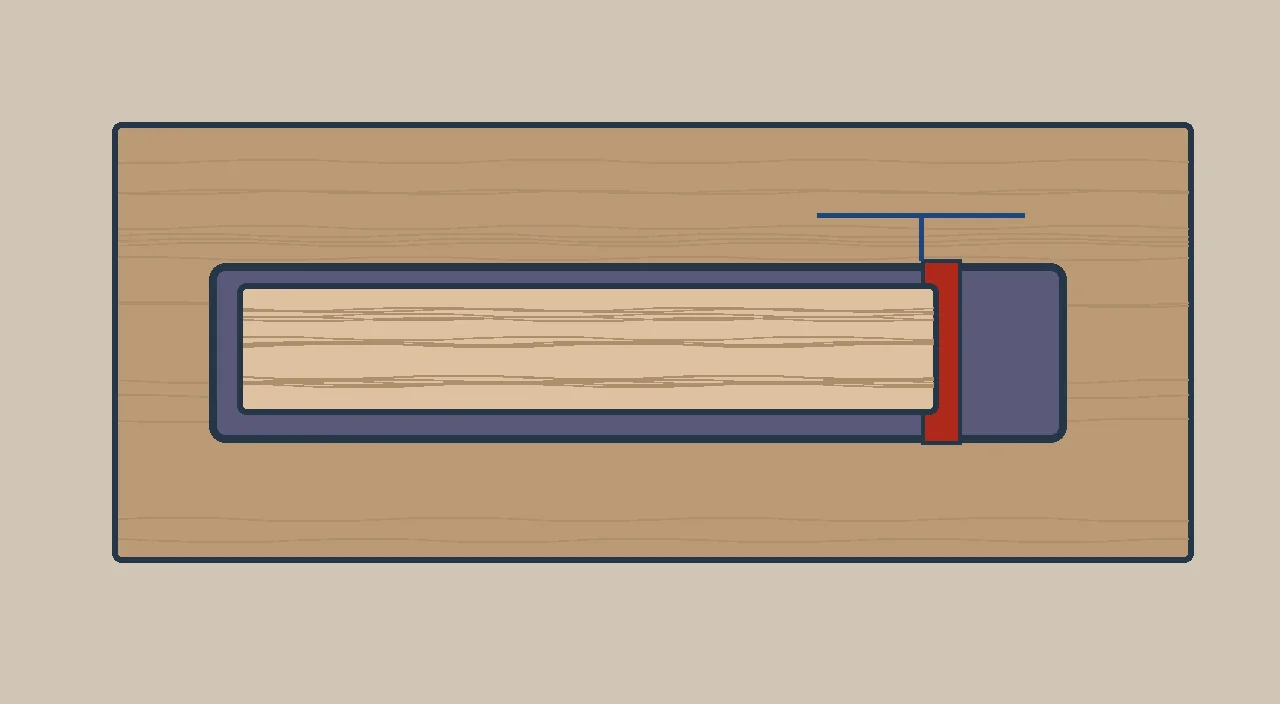
Swell Joint begins at a low workshop cabinet with a thin wooden shuttle suspended inside a groove. The game’s virtual humidity can change the width of the shuttle. The surrounding groove maintains the same drawn edges during the first test. A small button offers a new air condition. The record tells the player what happened to the wooden part and gives a separate indication of whether the hand control can move it. Finding a dry condition is only useful if the recorded shuttle has become narrow enough at the relevant moment.
Move one part of the system at a time
The concept can begin with three readable states for the shuttle. In the dry state a narrow gap sits between the shuttle and guide. In a neutral condition there is less space, but the movement is still available. Under the wet setting the expanded edge reaches a stopper. The game can open another test after the selected climate resolves. A control cue keeps the initial humidity from being mistaken for the actual recorded fit.
Choose a virtual setting, check what the simulator did with the wooden piece, and try a movement when it makes sense. If a push fails, the report gives the relevant part of the joint. It can identify the stopper location and the category the shuttle started from. The drawn gap stays available after the attempt. If the selected wet condition is changed to a dry one, a later comparison uses the same groove. A short readout shows whether the size has already shifted or the prior result is still present.
Show weather away from the fit
The cabinet art uses desaturated blue sides and pale wood laminations. A brick-red change marker can identify the place where the shuttle’s widened edge met the stop. The game can also use a plain phrase for clearance. This gives a reader a way to understand the display when the picture contains similar tones. The narrow chamber has a fixed profile line. A second layer shows how far the current specimen reaches across it. In a paused proof keep both outlines visible with their own labels.
A report can carry an illustrated room-wide view and a smaller view of the groove. In both, the left edge belongs to the cabinet and the right belongs to the shuttle. Preserve which orientation matters even if a detail has less surrounding space. The artistic setting is fictional and the image shows no exact real-world material measurements. A player needs only enough of the model to reason about what it recorded.
Establish the first repeatable difference
Swell Joint is in concept development. The prototype can start with one fixed groove and two finishes from the same original position. Give a player a chance to select the wet and dry results in any order. Ask which allowed the shuttle to move. A later exercise can use the transition from one rather than the settled condition only. If both states read correctly without travel animation, keep an earlier and later proof to compare with the eventual latch design.
Read The Stop Is in the Same Place for the fixed reference. Delayed Latch changes the response of two parts at different times. The simpler cabinet gives only one movable piece to read, which makes the role of material change more direct.