
The Stop Is in the Same Place
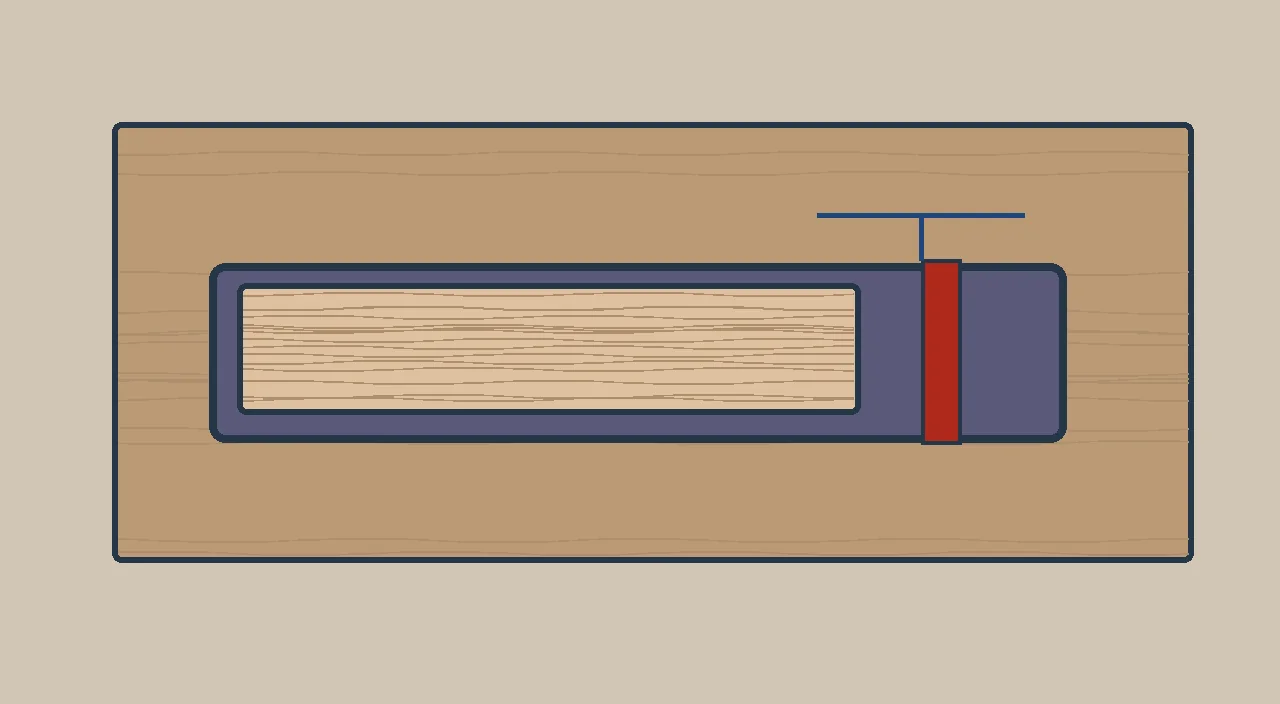
Two sketches on the bench show a wooden shuttle in a cabinet. The one on the left has a narrow gap. In the one on the right the shuttle reaches a red strip at the side. The drawings cover roughly the same area of paper. Turn them over and you might notice that the strip is slightly closer to the middle in the second sketch. That movement was accidental. The experiment meant to expand the virtual shuttle and let the stop stay where it was.
Find one line the model holds steady
The stop can follow a light notch cut into the cabinet’s fixed wall. Carry that notch into both pictures. Give the wooden edge of the shuttle a different perimeter so a reader can compare its width. A space opens between those two parts in the dry setting. The virtual wet state closes it in the other. If the stop itself moves in the art, we no longer get a clean comparison of the wood. A public proof can say which outline stayed fixed and which one changed under the simulated setting.
Use enough perspective to show there are two pieces. Draw the overlap along a front view where it can be checked without looking down a very dark groove. A separate small picture can show how a strap or handle fits into it. The useful change is the contact against the stop. A busy illustration could direct somebody’s attention to a reflection or texture instead. Keep the red stop on its real edge and describe the current clearance next to it. The angle remains the same while the piece grows or shrinks.
Move the setting in the result as well
If the gauge selection changes before the virtual object does, retain both. A label for dry air does not guarantee a newly clear opening until the game describes the wood’s response. In this early case the material can update promptly. It still helps to give the fit its own line. A report might state that the stop remained fixed and the shuttle was already in the dry size category. When a later test introduces a response interval, the earlier proof already has space for a meaningful material state.
The pictured evidence can support a short play comparison. Some readers want to see the selected setting. Others jump to the result after trying the hand control. In both routes the wall edge needs a stable lookup point. If a narrow crop leaves too little room for it, fit the diagram to the same reference or identify the mark in a caption. Use the same orientation in the row that names the wet and dry conditions. A curved rendered knob doesn’t need to mark the current state on its own.
Two proofs, one cabinet
Open Swell Joint and compare the outline for each condition with the same stop. First use a dry comparison and note where the gap remains. Then use the virtual wet case. Ask what changed in the two geometry drawings and what the actuator can do after that. A small amount of space can be read plainly when the same physical reference appears in both. If readers still point to a different part of the stop, change the illustration’s framing or caption before adding more rule detail.
A second exercise can keep the shuttle width fixed while the virtual cabinet is drawn at a different scale. This checks that people aren’t using the apparent length of the picture to estimate the opening. They need only recognize the way the two printed edges relate. The real material is outside this example. Every status and measurement concerns the game’s categorical fit.
Read The Small Tab Moves First for a case that changes multiple wooden parts at different steps. The stop in this one remains unchanged while the wood condition moves. Recording that fixed fact is the difference between a note that describes one useful result and two pictures that merely look related. A later build can introduce another groove with its own fixed reference.